

Showing posts with label Utah. Show all posts
Showing posts with label Utah. Show all posts
Tuesday, March 20, 2012

Wednesday, October 5, 2011
Kind of early for this, isn't it?
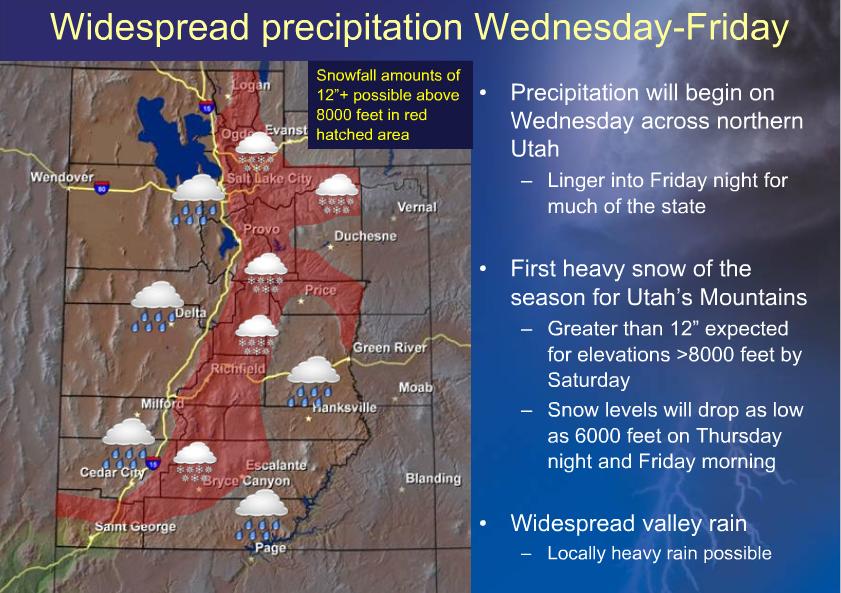
Significant Fall storm beginning Wednesday (Oct. 5) and continuing into Saturday morning.

Two storms in the Pacific will move into the western U.S. and an Alaskan upper area of low pressure will move in and bring substantially cooler temps.


Two storms in the Pacific will move into the western U.S. and an Alaskan upper area of low pressure will move in and bring substantially cooler temps.




Saturday, July 9, 2011
End of Space Shuttle Program Hits Utah Hard
For more than 30 years, NASA's space shuttle program has been a cornerstone of Utah's economy. That era ended Friday with the launch of Atlantis, which ends the shuttle program.
It stops the flow of hundreds of millions of dollars that came to Utah from the National Aeronautics and Space Administration for tests and construction of the solid-fuel rocket booster motors that launch the spacecraft into orbit. Gone, too, are thousands of jobs from Alliant Tech Systems, known as ATK, and other northern Utah companies that supported the industry.
"I never thought they should end the shuttle program until there was a replacement for it," said Jake Garn, a one-time shuttle astronaut and former U.S. senator. "It has been a big boon to Utah, and I just hate to see the program come to an end."
On clear nights, Fred Perkins said he often looks up to see the International Space Station fly past. It represents a million tons of equipment that ATK's booster motors helped put into orbit.
"And you can watch it in the sky as if it were a new star," said Perkins chief shuttle engineer for the company which built the motor. "When I watch the space shuttle lifting off, it is overwhelming. I am in awe that human beings can actually come together and do that kind of work."
Some say the end of the shuttle program doesn't necessarily mean the future is all doom and gloom for Utah.
ATK will almost certainly be involved in the nation's future space-flight efforts, which virtually guarantees Utah will play a role — although the state may have to weather some tough times until NASA again sends astronauts into space aboard an American-made rocket.
Northern Utah's Box Elder County will certainly feel the pain. The county is the home of ATK's Promontory plant, where booster motors were assembled and tested.
"The economy in Box Elder County is going to be adjusting ... for some time to come," said John Matthews, a labor market economist at the Utah Department of Workforce Services who tracks northern Utah's workforce.
Unemployment in the county currently sits at 9.2 percent, much higher than the statewide rate of 7.3 percent. Much of the difference can be traced to the loss of thousands of workers let got from ATK since the wind-down of the shuttle program began in 2009.
"It has been really devastating for a lot of people around here," said Leon Payne, a 71-year-old Tremonton resident and ATK retiree who recently saw of his two brothers-in-law and a son let go from the rocket motor maker.
Payne, who started worked at ATK predecessor, Thiokol Corp., out of high school in 1958, says it's clear that what ATK needs going forward is new contracts.
"It was a good place to work, and it helped build me a home, buy a little property and raise three kids," said Payne who worked on the 1981 launch of the first shuttle before moving to the propellant program. "Those jobs helped put a lot of meals on a lot of tables. But I'm worried it could be a long time before we see those jobs return."
Former Tremonton Mayor Max Weese, who worked at Thiokol in the 1960s and 1970s, said even residents who didn't work at ATK's Promontory plant understood its importance. He's confident the jobs will return and that area residents will again hear the roar of rocket test firings from the hills west of the city.
"You could hear it and see the exhaust climbing into the sky," he said. "It would rattle windows, and sometimes there would be dust settling on the cars. But if they made a mess in your yard, you could always call them and they'd come out and clean it up.
It stops the flow of hundreds of millions of dollars that came to Utah from the National Aeronautics and Space Administration for tests and construction of the solid-fuel rocket booster motors that launch the spacecraft into orbit. Gone, too, are thousands of jobs from Alliant Tech Systems, known as ATK, and other northern Utah companies that supported the industry.
"I never thought they should end the shuttle program until there was a replacement for it," said Jake Garn, a one-time shuttle astronaut and former U.S. senator. "It has been a big boon to Utah, and I just hate to see the program come to an end."
On clear nights, Fred Perkins said he often looks up to see the International Space Station fly past. It represents a million tons of equipment that ATK's booster motors helped put into orbit.
"And you can watch it in the sky as if it were a new star," said Perkins chief shuttle engineer for the company which built the motor. "When I watch the space shuttle lifting off, it is overwhelming. I am in awe that human beings can actually come together and do that kind of work."
Some say the end of the shuttle program doesn't necessarily mean the future is all doom and gloom for Utah.
ATK will almost certainly be involved in the nation's future space-flight efforts, which virtually guarantees Utah will play a role — although the state may have to weather some tough times until NASA again sends astronauts into space aboard an American-made rocket.
Northern Utah's Box Elder County will certainly feel the pain. The county is the home of ATK's Promontory plant, where booster motors were assembled and tested.
"The economy in Box Elder County is going to be adjusting ... for some time to come," said John Matthews, a labor market economist at the Utah Department of Workforce Services who tracks northern Utah's workforce.
Unemployment in the county currently sits at 9.2 percent, much higher than the statewide rate of 7.3 percent. Much of the difference can be traced to the loss of thousands of workers let got from ATK since the wind-down of the shuttle program began in 2009.
"It has been really devastating for a lot of people around here," said Leon Payne, a 71-year-old Tremonton resident and ATK retiree who recently saw of his two brothers-in-law and a son let go from the rocket motor maker.
Payne, who started worked at ATK predecessor, Thiokol Corp., out of high school in 1958, says it's clear that what ATK needs going forward is new contracts.
"It was a good place to work, and it helped build me a home, buy a little property and raise three kids," said Payne who worked on the 1981 launch of the first shuttle before moving to the propellant program. "Those jobs helped put a lot of meals on a lot of tables. But I'm worried it could be a long time before we see those jobs return."
Former Tremonton Mayor Max Weese, who worked at Thiokol in the 1960s and 1970s, said even residents who didn't work at ATK's Promontory plant understood its importance. He's confident the jobs will return and that area residents will again hear the roar of rocket test firings from the hills west of the city.
"You could hear it and see the exhaust climbing into the sky," he said. "It would rattle windows, and sometimes there would be dust settling on the cars. But if they made a mess in your yard, you could always call them and they'd come out and clean it up.
Wednesday, January 5, 2011
First Debris Removed from Provo Tabernacle
The first piece of debris in the investigation of the Provo Tabernacle was lifted out of the burned building by a crane on Jan. 5.
It's the next step Provo fire officials are using in their investigation to find out what started the fire on the morning of Dec. 17.
"Getting the debris out will help investigators actually get in and start going through, sifting through the rubble to find the cause," said Provo Deputy Fire Chief Gary Jolley. "They've isolated a few points of interest where they want to start."

With walls stabilized, the contractor begins hoisting the first pieces out of the burned Provo Tabernacle for examination.
Investigators had been waiting to go inside until the brick walls were stabilized by a contractor hired by The Church of Jesus Christ of Latter-day Saints.
According to Jolley, the cold weather in recent days is also making the investigation more difficult.
"The freezing temperatures do set us back, because if things are frozen together, it's harder to remove. We've been working with the contractor there and they have been trying to cover things up for us and heat things up, so the investigators can get in there and remove things that aren't stuck together," he said.
Each piece of debris is being moved onto the lawn north of the tabernacle, where it will be inspected and documented.
Investigators have already questioned dozens of people about the building, including those who were inside during a concert rehearsal just hours before the blaze was discovered.
They will consider all of the evidence they gather to help determine what caused the fire, in a daunting process that could still take several weeks.
It's the next step Provo fire officials are using in their investigation to find out what started the fire on the morning of Dec. 17.
"Getting the debris out will help investigators actually get in and start going through, sifting through the rubble to find the cause," said Provo Deputy Fire Chief Gary Jolley. "They've isolated a few points of interest where they want to start."

With walls stabilized, the contractor begins hoisting the first pieces out of the burned Provo Tabernacle for examination.
Investigators had been waiting to go inside until the brick walls were stabilized by a contractor hired by The Church of Jesus Christ of Latter-day Saints.
According to Jolley, the cold weather in recent days is also making the investigation more difficult.
"The freezing temperatures do set us back, because if things are frozen together, it's harder to remove. We've been working with the contractor there and they have been trying to cover things up for us and heat things up, so the investigators can get in there and remove things that aren't stuck together," he said.
Each piece of debris is being moved onto the lawn north of the tabernacle, where it will be inspected and documented.
Investigators have already questioned dozens of people about the building, including those who were inside during a concert rehearsal just hours before the blaze was discovered.
They will consider all of the evidence they gather to help determine what caused the fire, in a daunting process that could still take several weeks.
Monday, December 20, 2010
Provo Tabernacle Fire Investigation Begins
Fire investigators don't expect to have a cause on the Provo Tabernacle fire for several days, or possibly even weeks. That's because it will probably be a few days until they can safely go inside. Investigators must wait until the building is more stabilized.
 Monday at the Tabernacle, a contractor hired by the Church of Jesus Christ of Latter-day Saints began removing fall hazards from the top exterior of the building.
Investigators could be sifting through the ashen remains of the Provo Tabernacle for the cause of last week's fire as early as Tuesday morning.
A construction crew hired by the LDS Church spent Monday tearing down some remnants and removing debris from the fire-ravaged building to make it safer for investigators to search the rubble. Demolition included the remainder of the gabled end of the roof on the west side.

Investigators spent the day studying old construction and remodeling plans for the more than 100-year-old tabernacle. They're familiarizing themselves with the layout so they have an idea of where to start once they get inside, said Provo Deputy Fire Chief Gary Jolley.
"What they're trying to do is develop a game plan," he said.
Fire Marshal Lynn Schofield also interviewed performers who were rehearsing the night before the blaze broke out to better understand the conditions inside the tabernacle and how things were set up, he said.
"We have a couple hundred performers, cast members and crew members that we've got to talk to and we're working on that today as well as other people that might have knowledge of the building and the systems being used that day," Schofield said.
 Flames tore through the iconic building last Friday morning, gutting the interior. Debris piled 9 feet high covers the floor. The outside brick walls remain standing.
The site has been secured with a fence and is being guarded around the clock to ensure nothing inside is disturbed and to prevent anyone from trying to salvage anything from the building.
While many people are wondering if the Tabernacle will be rebuilt, the LDS Church has said it is too early to discuss what the future of the Tabernacle may be.

Officials have said once investigators get inside it could be days if not weeks before the cause is determined.
"This is going to be a long process because it's a large building," Jolley said.
In addition to the loss of the building, hundreds of thousands of dollars of personal property belonging to composer Lex de Azevedo and his Millennium Choral Society were destroyed in the fire.
Sunday night a benefit concert was held to raise money to cover those losses.
 Monday at the Tabernacle, a contractor hired by the Church of Jesus Christ of Latter-day Saints began removing fall hazards from the top exterior of the building.
 Investigators could be sifting through the ashen remains of the Provo Tabernacle for the cause of last week's fire as early as Tuesday morning.
A construction crew hired by the LDS Church spent Monday tearing down some remnants and removing debris from the fire-ravaged building to make it safer for investigators to search the rubble. Demolition included the remainder of the gabled end of the roof on the west side.

Investigators spent the day studying old construction and remodeling plans for the more than 100-year-old tabernacle. They're familiarizing themselves with the layout so they have an idea of where to start once they get inside, said Provo Deputy Fire Chief Gary Jolley.
"What they're trying to do is develop a game plan," he said.
Fire Marshal Lynn Schofield also interviewed performers who were rehearsing the night before the blaze broke out to better understand the conditions inside the tabernacle and how things were set up, he said.
"We have a couple hundred performers, cast members and crew members that we've got to talk to and we're working on that today as well as other people that might have knowledge of the building and the systems being used that day," Schofield said.
 Flames tore through the iconic building last Friday morning, gutting the interior. Debris piled 9 feet high covers the floor. The outside brick walls remain standing.
 The site has been secured with a fence and is being guarded around the clock to ensure nothing inside is disturbed and to prevent anyone from trying to salvage anything from the building.
While many people are wondering if the Tabernacle will be rebuilt, the LDS Church has said it is too early to discuss what the future of the Tabernacle may be.

Officials have said once investigators get inside it could be days if not weeks before the cause is determined.
"This is going to be a long process because it's a large building," Jolley said.
In addition to the loss of the building, hundreds of thousands of dollars of personal property belonging to composer Lex de Azevedo and his Millennium Choral Society were destroyed in the fire.
Sunday night a benefit concert was held to raise money to cover those losses.
Sunday, December 19, 2010
Provo Tabernacle Was "Part of Who We Are"
Nearly 2,000 people filed into the UCCU Center at Utah Valley University on Sunday night to mourn the loss of a historic building.
The memorial, and tribute, was held in honor of the Provo Tabernacle, which was ravaged by fire Friday. The cause of the blaze was still under investigation Sunday.
“This was more than a building; this building had a soul,” said Provo Mayor John Curtis in an hourlong service dedicated to the building. “It was a part of who we are.”

A performance of “Gloria” by the Millennium Choral Society was held after the service. The singing group had been scheduled to perform in the tabernacle. Utah Gov. Gary Herbert attended the service along with Republican Rep. Jason Chaffetz.
“For us, this is an icon,” he added. “We need that building there.”


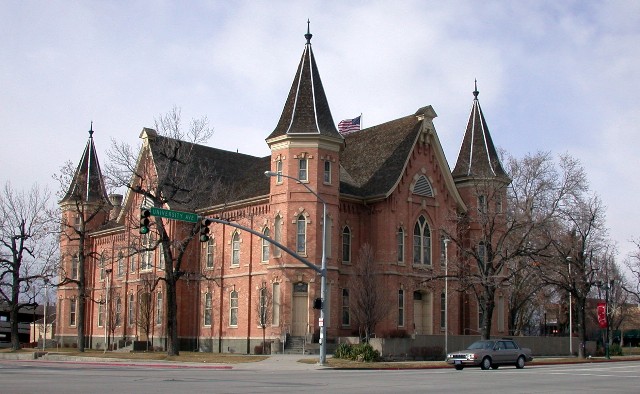
The completed Provo Tabernacle before the original tabernacle, whose spire is visible at the left of the picture, was demolished. Where that building stood, there is now a lush park cornering on Center Street and University Avenue. The stack of the heating plant is visible also on the left.
More Historical Tabernacle Photos
The memorial, and tribute, was held in honor of the Provo Tabernacle, which was ravaged by fire Friday. The cause of the blaze was still under investigation Sunday.
“This was more than a building; this building had a soul,” said Provo Mayor John Curtis in an hourlong service dedicated to the building. “It was a part of who we are.”
A performance of “Gloria” by the Millennium Choral Society was held after the service. The singing group had been scheduled to perform in the tabernacle. Utah Gov. Gary Herbert attended the service along with Republican Rep. Jason Chaffetz.
“For us, this is an icon,” he added. “We need that building there.”


The completed Provo Tabernacle before the original tabernacle, whose spire is visible at the left of the picture, was demolished. Where that building stood, there is now a lush park cornering on Center Street and University Avenue. The stack of the heating plant is visible also on the left.
More Historical Tabernacle Photos
Sunday, July 18, 2010
Big Fill Trail Hike and ATK - July 2010
During the first months of 1869, the valley to the east of the Promontory Mountains was filled with construction camps of the Union Pacific and Central Pacific Railroads. Many of these camps became short-lived "Hell-on- Wheels" towns with names like Deadfall, Last Chance, and Junction City. Today, virtually nothing remains of these construction camps, however, the workers' legacy of a hand built railroad has been preserved.
Hiking the 1 1/2 mile loop trail will allow you to see first-hand some of the railroad's most difficult hand-hewn achievements, including the Central Pacific's Big Fill and the site of the Union Pacific's Big Trestle.

The Big Fill was an engineering project on the First Transcontinental Railroad in the U.S. state of Utah. To avoid a costly 800 feet (240 m) tunnel through mountainous terrain east of Promontory Summit, Central Pacific engineers mapped an alternate route that still needed to span a deep ravine.
Over two months, 500 workers hauled more than 10,000 cubic yards of material to build the rail bed. At its extent, the fill extended for 500 feet (150 m) and up to a depth of 70 feet (21 m).


Within sight of the Big Fill, the Union Pacific line was also attempting to cross the ravine. The Union Pacific was several months behind Central Pacific, and opted to build a wooden trestle instead of using an earthen fill.

The Big Trestle was built in 36 days. Six months after the completion ceremony, Central Pacific was awarded control of the line from Promontory to Odgen. They opted to take the rail from the poor quality Big Trestle and move it to the Big Fill, which remained in use until the rails were removed in 1942. Today both sites are part of the Golden Spike National Historic Site where a walking trail allows visitors to see the Big Fill and the remains of the Big Trestle.

This view is looking south down Spring Creek ravine from the Central Pacific's upper grade. On the left and right of the ravine are the eastern and western abutments of Big Trestle.

Looking west along Big Fill. The South Promontory Mountains are on the horizon. To the left is Great Salt Lake. This view provides a clear view of the abutments of Big Trestle.

Not since tunneling through the Sierra Nevada did the Central Pacific confront such a rugged landscape. This portion of the railroad also represents the most grueling construction the Union Pacific undertook form Omaha to Promontory.

Grading crews could work up to 300 miles ahead of track laying crews. A meeting point had not been mandated to the companies and they had no incentive to cease construction as their work crews drew closer to one another. Consequently, they built grade past each other for 250 miles. When a meeting point was finally agreed upon, both companies discontinued grading beyond Promontory Summit. All along the trail there is both complete grade and partially constructed grade.
Central Pacific's grade is the upper grade and the Union Pacific's is the lower grade.


Rock cuts and fills had to be constructed along the route to bring it within the required grade of 2 percent or less. Cuts were made to create fill by a two man team called "double jackers", who drilled holes in solid rock using a long, narrow drill bit, which was repeatedly struck with a heavy sledge hammer or double jack.

After the hole was drilled, a worker called a "powder monkey" would fill it with black powder, carefully tamp and fuse the powder, and set off the charge. A successful blast would reduce rock to a size that could be shoveled into mule-drawn dump carts and taken to an area that needed to be filled.

When debris from construction of rock cuts wasn't needed, the rock was dumped into mounds called spoils piles. The piles were size-graded, featuring different sizes of rocks.
This harsh terrain was home to thousands of railroad workers during the final days of the railroad's construction. Several Union Pacific camps were scattered in the valley below and although many of these camps maintained reputations as "hell-on-wheels" towns, only Deadfall held this distinction in the Promontory area.
Deadfall at Promontory - An Archaeological Mystery
Tents at Promontory 1869
 This tranquil photograph of Union Pacific's Deadfall belies its rough and raucous reputation. (A.J. Russell photo)
The present day buildings in the distance are part of the ATK Launch Systems Group complex on Utah 83.


 Central Pacific's biggest problem: how to cross Spring Creek Ravine. Imagine placing the first small, mule-drawn dump cart load of fill at the bottom of the ravine. The work took over 2 months of intense effort by 250 dumpcart teams and more than 500 workers, totalling more than 101,000 cubic yards.
To span Spring Creek Ravine, the Union Pacific constructed the Big Trestle, which was located 150 feet east of hte Big Fill. Because it meant to be a temporary structure, construction of the Big Trestle took only 36 days. The trestle was 85 feet high and 400 feet long.
 (NPS PHOTO) About 8 months after completion of the transcontinental railroad, the Central Pacific gained control of the route from Promontory Summit to Ogden, Utah and trains began using the Big Fill rather than the Big Trestle.
Heading east past the site of the Big Fill and the Big Trestle, one passes through Carmichael's cut and then the wildlife becomes abundant.

This Great Basin Whiptail Lizard was almost invisible with his surroundings.

The "Cnemidophorus tigris tigris" is a terrestrial lizard of arid and semi-arid deserts to open woodlands where vegetation is sparse enough to make running easy. Their movements are rapid and jerky. They are among the most difficult lizards to capture.
Then two hawks began circling above.

Perhaps they were looking for lunch or maybe protecting something above me in the rocks.

Various shelters are scattered throughout the Promontory Mountains. They may have been used as a cache for construction materials or as shelter during blasting

Heading east around the next bend, more of ATK Launch Systems becomes visible across the valley.


The Promontory Mountains watched over the achievements of those who labored here. These achievements remain preserved at Golden Spike National Historic Site as a tribute to the perseverance and talents of all who worked to complete an engineering marvel and open a new chapter in our nation's history - the era of the railroad.
The Promontory Mountains continue to loom over the sprawling, isolated ATK facility, builders of NASA space shuttle rocket motors.

The plant, once designated as "Air Force Plant 78", once employed over three thousand people, who worked in 450 buildings, clustered in the various industrial and test areas that are scattered throughout the bare hills of the 30 square mile complex.


In 2001 Thiokol's propulsion division was acquired by Alliant Techsystems, a weapons and explosives manufacturer that operates a large plant outside Salt Lake City, the Bacchus Works.


ATK Launch Systems now faces a time of uncertainty and since April 2009, more than 1,900 people have left the company, voluntarily or otherwise, after defense and aerospace cutbacks in the shuttle and other missile programs.
Hiking the 1 1/2 mile loop trail will allow you to see first-hand some of the railroad's most difficult hand-hewn achievements, including the Central Pacific's Big Fill and the site of the Union Pacific's Big Trestle.

The Big Fill was an engineering project on the First Transcontinental Railroad in the U.S. state of Utah. To avoid a costly 800 feet (240 m) tunnel through mountainous terrain east of Promontory Summit, Central Pacific engineers mapped an alternate route that still needed to span a deep ravine.
Over two months, 500 workers hauled more than 10,000 cubic yards of material to build the rail bed. At its extent, the fill extended for 500 feet (150 m) and up to a depth of 70 feet (21 m).


Within sight of the Big Fill, the Union Pacific line was also attempting to cross the ravine. The Union Pacific was several months behind Central Pacific, and opted to build a wooden trestle instead of using an earthen fill.

The Big Trestle was built in 36 days. Six months after the completion ceremony, Central Pacific was awarded control of the line from Promontory to Odgen. They opted to take the rail from the poor quality Big Trestle and move it to the Big Fill, which remained in use until the rails were removed in 1942. Today both sites are part of the Golden Spike National Historic Site where a walking trail allows visitors to see the Big Fill and the remains of the Big Trestle.

This view is looking south down Spring Creek ravine from the Central Pacific's upper grade. On the left and right of the ravine are the eastern and western abutments of Big Trestle.

Looking west along Big Fill. The South Promontory Mountains are on the horizon. To the left is Great Salt Lake. This view provides a clear view of the abutments of Big Trestle.

Not since tunneling through the Sierra Nevada did the Central Pacific confront such a rugged landscape. This portion of the railroad also represents the most grueling construction the Union Pacific undertook form Omaha to Promontory.

Grading crews could work up to 300 miles ahead of track laying crews. A meeting point had not been mandated to the companies and they had no incentive to cease construction as their work crews drew closer to one another. Consequently, they built grade past each other for 250 miles. When a meeting point was finally agreed upon, both companies discontinued grading beyond Promontory Summit. All along the trail there is both complete grade and partially constructed grade.
Central Pacific's grade is the upper grade and the Union Pacific's is the lower grade.


Rock cuts and fills had to be constructed along the route to bring it within the required grade of 2 percent or less. Cuts were made to create fill by a two man team called "double jackers", who drilled holes in solid rock using a long, narrow drill bit, which was repeatedly struck with a heavy sledge hammer or double jack.

After the hole was drilled, a worker called a "powder monkey" would fill it with black powder, carefully tamp and fuse the powder, and set off the charge. A successful blast would reduce rock to a size that could be shoveled into mule-drawn dump carts and taken to an area that needed to be filled.

When debris from construction of rock cuts wasn't needed, the rock was dumped into mounds called spoils piles. The piles were size-graded, featuring different sizes of rocks.
This harsh terrain was home to thousands of railroad workers during the final days of the railroad's construction. Several Union Pacific camps were scattered in the valley below and although many of these camps maintained reputations as "hell-on-wheels" towns, only Deadfall held this distinction in the Promontory area.
Deadfall at Promontory - An Archaeological Mystery
Tents at Promontory 1869
 This tranquil photograph of Union Pacific's Deadfall belies its rough and raucous reputation. (A.J. Russell photo)
The present day buildings in the distance are part of the ATK Launch Systems Group complex on Utah 83.


 Central Pacific's biggest problem: how to cross Spring Creek Ravine. Imagine placing the first small, mule-drawn dump cart load of fill at the bottom of the ravine. The work took over 2 months of intense effort by 250 dumpcart teams and more than 500 workers, totalling more than 101,000 cubic yards.
To span Spring Creek Ravine, the Union Pacific constructed the Big Trestle, which was located 150 feet east of hte Big Fill. Because it meant to be a temporary structure, construction of the Big Trestle took only 36 days. The trestle was 85 feet high and 400 feet long.
 (NPS PHOTO) About 8 months after completion of the transcontinental railroad, the Central Pacific gained control of the route from Promontory Summit to Ogden, Utah and trains began using the Big Fill rather than the Big Trestle.
Heading east past the site of the Big Fill and the Big Trestle, one passes through Carmichael's cut and then the wildlife becomes abundant.

This Great Basin Whiptail Lizard was almost invisible with his surroundings.

The "Cnemidophorus tigris tigris" is a terrestrial lizard of arid and semi-arid deserts to open woodlands where vegetation is sparse enough to make running easy. Their movements are rapid and jerky. They are among the most difficult lizards to capture.
Then two hawks began circling above.

Perhaps they were looking for lunch or maybe protecting something above me in the rocks.

Various shelters are scattered throughout the Promontory Mountains. They may have been used as a cache for construction materials or as shelter during blasting

Heading east around the next bend, more of ATK Launch Systems becomes visible across the valley.


The Promontory Mountains watched over the achievements of those who labored here. These achievements remain preserved at Golden Spike National Historic Site as a tribute to the perseverance and talents of all who worked to complete an engineering marvel and open a new chapter in our nation's history - the era of the railroad.
The Promontory Mountains continue to loom over the sprawling, isolated ATK facility, builders of NASA space shuttle rocket motors.

The plant, once designated as "Air Force Plant 78", once employed over three thousand people, who worked in 450 buildings, clustered in the various industrial and test areas that are scattered throughout the bare hills of the 30 square mile complex.


In 2001 Thiokol's propulsion division was acquired by Alliant Techsystems, a weapons and explosives manufacturer that operates a large plant outside Salt Lake City, the Bacchus Works.


ATK Launch Systems now faces a time of uncertainty and since April 2009, more than 1,900 people have left the company, voluntarily or otherwise, after defense and aerospace cutbacks in the shuttle and other missile programs.
Tuesday, June 15, 2010
Once again, Utah comes in No. 1 in volunteering
Once again, Utah comes in No. 1 in volunteering
The Salt Lake Tribune
Updated: 06/15/2010 04:02:31 PM MDT
Utah has topped the nation in volunteering for the fifth year in a row, with the nation's highest rate of residents giving back to their communities.
With participation at 44.2 percent of adults, Utah far exceeds the national average of 22.8 percent.
"If you think about what attracts companies to Utah ... they feel this spirit," said Spencer Eccles, executive director of the governor's Office of Economic Development.
State and local leaders gathered Tuesday at the capitol to announce the ranking, which comes from the 2010 Volunteering in America report. Statewide, an estimated 906,000 Utahns volunteered 200 million hours in 2009.
Residents ages 55 to 64 most frequently volunteer.
Among mid-size cities, Provo had the highest volunteering rate nationwide, with 63.6 percent participation. "Volunteering is part of who we are," said Provo Mayor John Curtis.
Volunteering in Utah comes in all forms, from giving tours at The Living Planet Aquarium in Sandy to teenagers growing food to give to the poor through Utah G.A.R.D.E.N.S. The recent Chevron oil spill, which sent 33,000 gallons into Red Butte Creek, inspired citizens to contact Salt Lake City about how they could help.
"A large majority are asking how they can help the birds," said Karen Hale, the communications director. "We are lucky to have great communities here."
The Utah Commission on Volunteers is challenging citizens of all ages to volunteer in its Summer of Service campaign, competing for lunch with Lt. Gov. Greg Bell. And by working for 50 to 100 hours, depending on age group, participants can earn a Presidential Service Award.
In a Summer of Service kick-off last weekend, volunteers did landscaping at Provo's North Park and dug out grass from around sycamore and ash trees.
Last year, 13-year-old Amber Barron of Riverton won her age category in the state's competition, logging 64 hours of service at the Girl Scouts' three-day Camporee and setting up a blog for a camp held in Philadelphia and Washington, D.C.
This summer, she has been selected as a delegate for the Girl Scouts of Utah, and also will serve as a program aide for A Journey to The Past, a three-day camp that teaches children about their Utah heritage.
"I am hoping to be the top volunteer in [my] age group," she said. "I am hoping to log over 100 hours this year."
In Murray, the Youth Chamber of Commerce is helping children as young as 3 become more active in their community, said program director Sheri Van Bibber. While a teenager may have a what's-in-it-for-me mentality, she said, "if we start with them younger, we can reverse that train of thought."
Murray youth helped dig mud out of a flooded apartment building carport last week; this summer, they will help with projects from cleaning up the Jordan River to painting faces at the town's Fourth of July parade.
Despite Utah's success, Bell reminded the crowd Tuesday the state can't stop giving back. It's necessary to continue to inspire each other, he said. "We know there is much work to be done," he said.
Tribune reporter Samuel Weigley contributed to this report.
The Salt Lake Tribune
Updated: 06/15/2010 04:02:31 PM MDT
Utah has topped the nation in volunteering for the fifth year in a row, with the nation's highest rate of residents giving back to their communities.
With participation at 44.2 percent of adults, Utah far exceeds the national average of 22.8 percent.
"If you think about what attracts companies to Utah ... they feel this spirit," said Spencer Eccles, executive director of the governor's Office of Economic Development.
State and local leaders gathered Tuesday at the capitol to announce the ranking, which comes from the 2010 Volunteering in America report. Statewide, an estimated 906,000 Utahns volunteered 200 million hours in 2009.
Residents ages 55 to 64 most frequently volunteer.
Among mid-size cities, Provo had the highest volunteering rate nationwide, with 63.6 percent participation. "Volunteering is part of who we are," said Provo Mayor John Curtis.
Volunteering in Utah comes in all forms, from giving tours at The Living Planet Aquarium in Sandy to teenagers growing food to give to the poor through Utah G.A.R.D.E.N.S. The recent Chevron oil spill, which sent 33,000 gallons into Red Butte Creek, inspired citizens to contact Salt Lake City about how they could help.
"A large majority are asking how they can help the birds," said Karen Hale, the communications director. "We are lucky to have great communities here."
The Utah Commission on Volunteers is challenging citizens of all ages to volunteer in its Summer of Service campaign, competing for lunch with Lt. Gov. Greg Bell. And by working for 50 to 100 hours, depending on age group, participants can earn a Presidential Service Award.
In a Summer of Service kick-off last weekend, volunteers did landscaping at Provo's North Park and dug out grass from around sycamore and ash trees.
Last year, 13-year-old Amber Barron of Riverton won her age category in the state's competition, logging 64 hours of service at the Girl Scouts' three-day Camporee and setting up a blog for a camp held in Philadelphia and Washington, D.C.
This summer, she has been selected as a delegate for the Girl Scouts of Utah, and also will serve as a program aide for A Journey to The Past, a three-day camp that teaches children about their Utah heritage.
"I am hoping to be the top volunteer in [my] age group," she said. "I am hoping to log over 100 hours this year."
In Murray, the Youth Chamber of Commerce is helping children as young as 3 become more active in their community, said program director Sheri Van Bibber. While a teenager may have a what's-in-it-for-me mentality, she said, "if we start with them younger, we can reverse that train of thought."
Murray youth helped dig mud out of a flooded apartment building carport last week; this summer, they will help with projects from cleaning up the Jordan River to painting faces at the town's Fourth of July parade.
Despite Utah's success, Bell reminded the crowd Tuesday the state can't stop giving back. It's necessary to continue to inspire each other, he said. "We know there is much work to be done," he said.
Tribune reporter Samuel Weigley contributed to this report.
Subscribe to:
Posts (Atom)