Subscribe News Feed Subscribe Comments

Showing posts with label Crime. Show all posts

Wednesday, July 14, 2010

Those Who Live By the Gun, Die By the Gun

Those Who Live By the Gun, Die By the Gun
---Ronnie Lee Gardner, 3 weeks ago.

The Utah State Prison is seen at sundown before the scheduled execution of Ronnie Lee Gardner by firing squad Thursday, June 17, 2010 in Salt Lake City. Gardner, 49, was sentenced to death for a 1985 capital murder conviction stemming from the fatal courthouse shooting of attorney Michael Burdell during an escape attempt. The execution is scheduled for just past midnight June 18, 2010.


The World's Most Barbaric Punishments
---Newsweek, July 9, 2010

An Iranian woman was spared being stoned to death for adultery this week, in response to international outcry. But the barbaric punishment is not the only medieval remedy still meted out by courts around the world.

Blinding

In 2003 an Indian citizen working in Saudi Arabia took part in a brawl, wounding a man's eye. Puthan Veettil Abd ul-Latif Noushad was eventually sentenced, in 2005, to have his own right eye gouged out as punishment. It was, according to charity Human Rights Watch, the third eye-gouging sentence handed down within a year. HRW was unable to confirm whether any of the gougings had actually taken place. In Noushad's case, the Indian government made an appeal for clemency. It is not clear if the appeal was successful. The State Department, on its website, still lists eye-gouging as a punishment that can be handed down by courts in Saudia Arabia.

Iran also allows chemical blinding. In 2005 a 27-year-old man named only as Majid had been stalking a woman, Ameneh Bahrami. When she refused his advances he poured a container of sulphuric acid over her. Bahrami was blinded and disfigured. Majid was sentenced to have five drops of hydrochloric acid dripped into each open eye, blinding him.

Amputation

Right hands have been cut off at the wrist as punishment for theft in Sharia-controlled areas of Nigeria and in Saudi Arabia. Repeat offenders in the latter country can lose both hands, and legs are sometimes taken for other offenses. An executioner, Muhammad Saad al-Beshi, told the Saudi newspaper Arab News in 2003 that "I use a special sharp knife, not a sword. When I cut off a hand I cut it from the joint. If it is a leg the authorities specify where it is to be taken off, so I follow that."

In Iran, in early 2008, five robbers had their right hands and left feet cut off in one week—a practice known as cross amputation. According to The New York Times "doctors watched to limit bleeding and infection during the procedure." Hands and feet are also reportedly cut off as punishment in Yemen, Sudan, and Somalia.

Beheading

Recent figures suggest that about 100 people per year are beheaded in Saudi Arabia. According to unconfirmed reports the condemned are given tranquilizers, and taken to a public square after midday prayers. They are forced to kneel facing Mecca, over a blue plastic sheet. "With one stroke of the sword I severed his head. It rolled meters away," said one executioner, al-Beshi.

Shooting

Ronnie Lee Gardner, a convicted murderer who elected to die by firing squad, was strapped to a chair at a prison in Draper, Utah, and shot with .30 caliber bullets just after midnight on June 18 this year.

According to the Associated Press his head was "secured by a strap across his forehead. Harness-like straps constrained his chest. His handcuffed arms hung at his sides. A white cloth square affixed to his chest over his heart—maybe 3 inches across—bore a black target."

Five police officers took aim from 25 feet away—four of the guns were loaded and one contained a blank, so no officer could know definitively that he had killed Gardner.

It was the first U.S. death by firing squad in 14 years.

Flogging and caning

Singapore administers caning for many offenses—including overstaying a 90-day tourist visa. The punishment is also common in Malaysia and Brunei. Unconfirmed reports suggest that officials use a thick rattan cane, four feet long and half an inch in diameter, soaked in water. This picture set and video from Malaysia—which we strenuously do not recommend you click through to—suggests that offenders are strapped naked to an A-frame and struck repeatedly with the cane, raising blood and welts. Foreign nationals are not immune—American Michael Fay was flogged in Singapore in 1994, despite pleas from President Clinton, and a Swiss man received three strokes last month The World's Most Barbaric Punishments
Stoning is not the only cruel and unusual measure courts around the world—and in America—hand out.
An Iranian woman was spared being stoned to death for adultery this week, in response to international outcry. But the barbaric punishment is not the only medieval remedy still meted out by courts around the world.

Blinding

In 2003 an Indian citizen working in Saudi Arabia took part in a brawl, wounding a man's eye. Puthan Veettil Abd ul-Latif Noushad was eventually sentenced, in 2005, to have his own right eye gouged out as punishment. It was, according to charity Human Rights Watch, the third eye-gouging sentence handed down within a year. HRW was unable to confirm whether any of the gougings had actually taken place. In Noushad's case, the Indian government made an appeal for clemency. It is not clear if the appeal was successful. The State Department, on its website, still lists eye-gouging as a punishment that can be handed down by courts in Saudia Arabia.

Iran also allows chemical blinding. In 2005 a 27-year-old man named only as Majid had been stalking a woman, Ameneh Bahrami. When she refused his advances he poured a container of sulphuric acid over her. Bahrami was blinded and disfigured. Majid was sentenced to have five drops of hydrochloric acid dripped into each open eye, blinding him.

Amputation

Right hands have been cut off at the wrist as punishment for theft in Sharia-controlled areas of Nigeria and in Saudi Arabia. Repeat offenders in the latter country can lose both hands, and legs are sometimes taken for other offenses. An executioner, Muhammad Saad al-Beshi, told the Saudi newspaper Arab News in 2003 that "I use a special sharp knife, not a sword. When I cut off a hand I cut it from the joint. If it is a leg the authorities specify where it is to be taken off, so I follow that."

In Iran, in early 2008, five robbers had their right hands and left feet cut off in one week—a practice known as cross amputation. According to The New York Times "doctors watched to limit bleeding and infection during the procedure." Hands and feet are also reportedly cut off as punishment in Yemen, Sudan, and Somalia.

Beheading

Recent figures suggest that about 100 people per year are beheaded in Saudi Arabia. According to unconfirmed reports the condemned are given tranquilizers, and taken to a public square after midday prayers. They are forced to kneel facing Mecca, over a blue plastic sheet. "With one stroke of the sword I severed his head. It rolled meters away," said one executioner, al-Beshi.

Shooting

Ronnie Lee Gardner, a convicted murderer who elected to die by firing squad, was strapped to a chair at a prison in Draper, Utah, and shot with .30 caliber bullets just after midnight on June 18 this year.

According to the Associated Press his head was "secured by a strap across his forehead. Harness-like straps constrained his chest. His handcuffed arms hung at his sides. A white cloth square affixed to his chest over his heart—maybe 3 inches across—bore a black target."

Five police officers took aim from 25 feet away—four of the guns were loaded and one contained a blank, so no officer could know definitively that he had killed Gardner.

It was the first U.S. death by firing squad in 14 years.

Flogging and caning

Singapore administers caning for many offenses—including overstaying a 90-day tourist visa. The punishment is also common in Malaysia and Brunei. Unconfirmed reports suggest that officials use a thick rattan cane, four feet long and half an inch in diameter, soaked in water. This picture set and video from Malaysia—which we strenuously do not recommend you click through to—suggests that offenders are strapped naked to an A-frame and struck repeatedly with the cane, raising blood and welts. Foreign nationals are not immune—American Michael Fay was flogged in Singapore in 1994, despite pleas from President Clinton, and a Swiss man received three strokes last month for a similar offense.

Flogging, or lashing with a whip or strap, is widespread. It is used in Iran, Saudi Arabia, Sudan, the United Arab Emirates, and the Bahamas, among others, for offenses from theft to adultery. In the Swat region of northwestern Pakistan, where the Taliban have de facto power, a commander was videotaped flogging a woman last year. The New York Times reported that she may have stepped out of her house without being escorted by a male, or spurned a local Taliban chief's advances. In any case, she was held face down and beaten with a leather strap, while a large circle of men watched. "Leave me for the moment — you can beat me again later,” she screamed, according to the Times, "pleading for a reprieve and writhing in pain."

Stoning

Convicted of adultery, 43-year-old Sakineh Mohammadi Ashtiani narrowly escaped being stoned to death in Iran this week. According to Amnesty International, the Iranian Penal Code specifies that "stones are large enough to cause pain, but not so large as to kill the victim immediately." Article 102 of the Penal Code states that men should be buried up to their waists and women up to their breasts for the purpose of execution by stoning. Article 104 states, with reference to the penalty for adultery, that the stones used should "not be large enough to kill the person by one or two strikes; nor should they be so small that they could not be defined as stones." The punishment is also used in Saudi Arabia and Somalia.

A young woman, Aisho Ibrahim Dhuhulow, was buried up to her neck and stoned to death in front of a large crowd in the Somali city of Kismayo in 2008, according to the BBC. "She was asked several times to review her confession but she stressed that she wanted Sharia law and the deserved punishment to apply," said a local Islamist leader.


Thursday, June 17, 2010

Gardner's Victims Share Pain, Divided on Execution

Jenny Brundin (2010-06-17)

SALT LAKE CITY, UT (kuer) - Utah's death row inmate Ronnie Lee Gardner is set to be executed just after midnight tonight. The families of Gardner's victims have shared the same wrenching pain for the 25 years he's been on death row. But some of them have very different views on his execution. KUER's Jenny Brundin tells their stories.

For 25 years Ronnie Lee Gardner has tried to evade the death chamber. And for 25 years Veldean Kirk has waited to see him walk into it.

KIRK: It'll be a closure, because for 25 years, it hasn't closed a bit.

Kirk and her daughter Tami Stewart are sitting at the kitchen table. The Sunday paper is spread out in front of them. There's a full day spread on what happened April 2, 1985. That's the day a bullet ripped through Kirk's husband's stomach.

STEWART: He was still facing him. KIRK: He was facing Gardner, and Gardner had the gun in his hand .

Every detail of that day is burned into their memories. Gardner was in court on a murder charge when he tried to escape using a gun slipped to him by an accomplice. As he fled, he shot and killed attorney Michael Burdell, and severely wounded Nick Kirk. For a quarter of a century, the victims' families have lived the anguish of not knowing whether or not Gardner would be put to death.


Here's Barb Webb, Kirk's older daughter.

WEBB: Every time Gardner's names brought up, he's either appealing this, he wants the death penalty, then he doesn't want the death penalty, it brings everything back that happened on April 2, 1985 over and over again. We all have to relieve it. Every single family has to go through the same thing that they went through on that day. Enough is enough.

Where Barb comes across as tough and angry, her younger sister Tami Stewart is tender and cries easily. The family calls her the soft-hearted one. What happened to her father twenty-five years ago has been present every day of her life.

STEWART: It's a mess. And I'm tired, like Barb, I'm tired of hearing his name, and I'm tired of remember how Dad felt that day and how sad it was .I'm just tired of it.


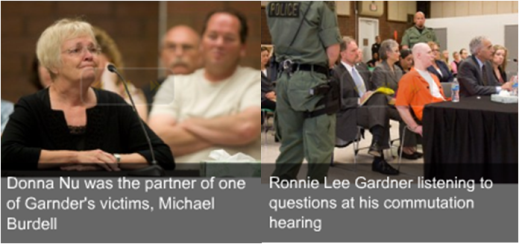
Donna Nu met Michael Burdell, the man who six years later would be one of Gardner's victims, at discussion group in Arizona. They would talk about who they were, why humans were on Earth, and the nature of creation - and they tried to practice the concepts they learned about.

NU: Well Michael would invariably verbalize exactly what I'd experienced.

The two would drive up once a month to Salt Lake City to take classes in spirituality. Their relationship deepened and evolved. Nu remembers vividly a night they spent together visiting a Vietnam veteran friend at the VA hospital after they'd both moved to Salt Lake City. She drove Burdell home.


NU: He said thank you in such a way that jolted my soul - it was a thank you that was more than just thanks for the ride. It just went very deep.

The next day Michael Burdell was murdered. As Ronnie Lee Gardner tried to escape from a Salt Lake City courthouse, he shot Burdell in the face. The bullet entered Burdell's eye at point blank range. Nu remembers seeing him in the hospital..

NU: And then it was like it was like I had run full force on, into a brick wall, that's what it felt like.

The Kirk family is tight-knit. They like to joke around and have fun. And Nick Kirk was the ring-leader. The father and grandfather everyone loved. He liked to scare the grandchildren on Halloween; he took them boating and fishing. And his two daughters Tami Stewart and Barb Webb say he loved to laugh.

WEBB: On April 2, 1985, that all changed, because he wasn't that type of person. STEWART: He was in pain.

Webb holds up a picture of her father.

WEBB: He went from looking like this, to a year and half after he was totally grey, he was like this little old man he couldn't do anything.

STEWART: But Dad did forgive Ronnie Lee before he died, that's what he told me, and he told me that I needed to do. WEBB: I think he did it because you're the one with the soft hearted one.

Webb tells her sister that her father did that because Stewart's the one with the soft heart. She thinks her father died hating Gardner.

WEBB: He knew his life as hunting and fishing and taking his grandchildren boating, and Gardner took all of that away from him that day he shot him.

Tami Stewart says she doesn't hate Gardner anymore, she feels sorry for him. But she can't forgive him. She imagines him sitting in the death chamber.

STEWART; He's going to feel that fear that he put into every one of those men. He's done, we've given him more than enough I think.

For Michael Burdell's family, putting Gardner to death they say, is not what Michael would have wanted. His father, Joseph Burdell Jr., testified that his murdered son would not want Gardner to die in his name. Donna Nu feels the same. She remembers her partner as a gentle, positive soul who was for life.

NU: He certainly wouldn't want to be the reason that Ronnie Lee was killed.

Nu never had hatred for Ronnie Lee Gardner, she was too consumed with the loss of her partner. And she knew she had to move on.

DONNA: If I would have dwelt on it anymore, it probably would have killed me. I had to go beyond it. I had to use it as a launching point to go beyond. Because I had no choice. I could wallow, or I could go beyond.

Gardner recently contacted Donna Nu and by telephone, they had a lengthy conversation.

NU: He is sorry for it, he is sorry for what he's done. And he had no idea of the ramification that would he caused from all this. All he knew was what the little life he knew, he knew nothing beyond that. He'd never experienced .caring. He'd never experienced anything that we might call normal life. All he knew was the violence that he knew and the chaos that he grew up with. MUSIC

Kirk sits alone at her kitchen table, the telephone phone in front of her. Her family stands nearby. Ronnie Lee Gardner has requested to talk with her to apologize. Several minutes pass. KIRK: I wonder if I was supposed to call him? DAUGHTERS: No, you wouldn't have .

45 more minutes pass.

KIRK: Now, I'm getting kind of angry.

The family has to call the prison to see what's going on. Because of miscommunication and the fact that a documentary team is present to interview Kirk only afterwards, the call doesn't happen. It turns out, Gardner, wanted to talk to the families privately. So the family was left waiting, with no phone call.

KIRK: You think he, they, would have at least tried to call to explain what was going on.


Donna Nu and Michael Burdell's father haven't met VelDean Kirk's family. Both families say they respect how each other feels about executing Gardner. Donna Nu:

DONNA: and I understand their pain because I had it for ..I still so I know the pain.

She just simply cannot understand the death penalty.

DONNA: What are we doing? What purpose are we serving? What are we gaining? .why would we kill each other?

And VelDean Kirk struggles with comprehending the views of Donna Nu and Michael Burdell's father, Joseph.

KIRK: How could you stand there and say you don't believe in the death penalty and he shouldn't die when he killed your son? I mean, I just can't understand that way of thinking!

VelDean Kirk will be a witness to Gardner's execution.

It's Monday. VelDean Kirk is leaving the prison. The Board of Pardons has just denied Gardner's request for life without parole. Kirk says his execution will bring closure.

KIRK: It'll just be over with. I don't know how to explain it. It'll be over with.

No one from Michael Burdell's family will be there. But Donna Nu says she and Michael believed that life is eternal. They often talked about their next lives. She says Burdell was excited, and looking forward to it. It just came too soon.

Ronnie Lee Gardner: Is Utah firing squad a more humane execution?

Ronnie Lee Gardner, who is scheduled to be executed by firing squad in Utah just past midnight local time Friday, raises questions about the relative humaneness of methods of execution.


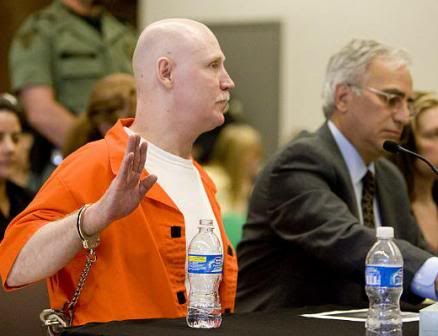
Ronnie Lee Gardner raises his restrained hand as he is sworn in before speaking at his commutation hearing at the Utah State Prison in Draper, Utah, on June 10. Next to him is his attorney Andrew Parnes. Convicted of two murders, Mr. Gardner faces execution by firing squad at 12:05 a.m. Friday. Trent Nelson/AP/Pool

By Daniel B. Wood, Staff writer / June 17, 2010

Ronnie Lee Gardner is scheduled to be executed at 12:05 a.m. Friday in the Utah State Prison, spotlighting a long list of sensitive issues about the death penalty, ranging from cost to crime deterrence to the relative humaneness of specific methods, such as firing squad.

Mr. Gardner, convicted of two murders – one during a courthouse escape attempt in 1985 – had been selected to die by lethal injection. But in an April court hearing he said, “I would like the firing squad, please.”

There is some evidence that firing squad is less "barbaric" than lethal injection, says John Holdridge, director of the Capital Punishment Project of the American Civil Liberties Union (ACLU), which campaigns against the death penalty.

A Utah inmate who in 1938 agreed to be shot to death while hooked up to an electrocardiogram showed complete heart death within one minute of the firing squad's shots. By contrast, research shows that a lethal injection – if done properly – takes about nine minutes to kill an inmate.

Support for death penalty dropping

Polls show public support of the death penalty has been dropping steadily since the 1990s, partly because of the number of convictions shown to be wrong by The Innocence Project, a national litigation and public policy organization dedicated to exonerating wrongfully convicted people through DNA testing.

Mr. Holdridge says the number of proven, wrongful executions has now reached 138. And Cleveland-based criminal defense attorney Elizabeth Kelley says that 250 exonerations of death-row defendants in recent years, coupled with medical procedural TV shows such as CBS’s “CSI: Crime Scene Investigation,” have made the public more sophisticated about the fallibility of scientific evidence.

Holdridge says the Gardner execution by firing squad will be more dramatic and argues that it will raise more public opposition to the death penalty itself than would a lethal injection, which makes the death appear more humane and clinical.

“The Gardner execution really brings to the spotlight what we are doing – exterminating a human life in a deliberate, premeditated fashion,” Holdridge says. He notes that one of the five rifles is loaded with a blank round so that each shooter is uncertain about whether or not he fired a fatal shot.

But is it also a deterrent? Dr. Allison Cotton, associate professor of criminology at the Metropolitan State College of Denver, says shooting a convict sends a mixed message.

“Shooting a person because he shot a person to death – to deter others from shooting people – is faulty reasoning,” says Cotton.

Leaving aside the personal motivations for choosing to be shot, which some have suggested might be for political reasons, Cotton says the pain factor is unknowable. Lethal injection takes time, and is achieved in three stages, Cotton points out. The first injection makes the person unconscious. A second injection paralyzes muscles so they can’t move. And a third stops the heart.

“There is no way of knowing how much pain this causes because the person is unconscious,” she says.

Death-penalty costs

As to cost, Cotton says the average execution – whatever method – costs $2.3 million dollars, compared to $500,000 to $700,000 for life in prison without parole.

In 2006, the United States Supreme Court ruled that death-row inmates in the United States could challenge the constitutionality of states' lethal injection procedures through a federal civil rights lawsuit.

Since then, numerous death-row inmates have brought such challenges in the lower courts, claiming that lethal injection as currently practiced violates the ban on "cruel and unusual punishment" found in the Eighth Amendment to the US Constitution.

Lower courts evaluating these challenges have reached opposing conclusions.

For example, courts have found that lethal injection as practiced in California, Florida, and Tennessee is unconstitutional while other courts have found that lethal injection as practiced in Missouri, Arizona, and Oklahoma is constitutionally acceptable.

Family, friends say goodbye to Gardner

Family, friends say goodbye to Gardner
June 17th, 2010 @ 5:54pm
By Jennifer Stagg


DRAPER -- While Ronnie Lee Gardner spends his last day in prison, his family says they're coming to terms with his impending execution.

Gardner's daughter and brother visited the prison Wednesday night, their final visit with Ronnie Lee. His daughter, Brandie, and brother, Randy, say they believe Ronnie Lee is a changed man since he first entered prison. They hope Ronnie Lee Gardner's life will serve as a warning to others going down the same path. Both said they hope the public has compassion for their situation, as they say they are victims as well.


Brandie was under the age of 2 when her father was sent to prison. On the day of his execution she tearfully spoke of how much she loves him.

"He told me that he loved me and to take care of my kids, and just to be strong and that he'll be around," she said.

Brandie Gardner can't remember life without her father in prison. Friday, she'll have to adjust to life after his execution.

"He'll always be with me," Brandie said. "He always has, he always will."

Both Brandie and Randy say they are not attending the execution tonight, at Gardner's request. They will spend the evening at a vigil celebrating Ronnie Lee's life -- one they say was misguided.

"He, in a lot of ways, believes in the death penalty," Randy said of his brother. "He also believes in ‘an eye for an eye.' His victims got killed by a bullet. Why shouldn't he get killed by a bullet?"

"No matter that we can't physically can't be there with him, I'll be there for him as close as I possibly can. I'll be praying," said Debbie, who asked we don't identify her beyond first name. She has maintained a more than 25-year relationship with Gardner -- the entire time he's been in prison.

She says they were lovers, but stopped their physical relationship. They referred to each other as "best friends." Thursday night, when he is put to death, she'll be remembering the good in a convicted murderer.

"Yesterday I got to talk to him, and I just told him that he knew that I loved him and I love him from the bottom of my heart, and our friendship was true and pure," Debbie said.

Ronnie Lee Gardner allowed to touch his family through prison bars
By Aaron Falk
Deseret News
Published: Thursday, June 17, 2010 5:51 p.m. MDT


DRAPER — Friends and family of Ronnie Lee Gardner hugged and wiped tears from their eyes Thursday, as they gathered in a parking lot overlooking the Utah State Prison and waited for Gardner to die.

"It's hard to say goodbye to somebody you love," said Brandie Gardner, the convicted killer's daughter.

Brandie Gardner, the daughter of Ronnie Lee Gardner, speaks about her last meeting with father Ronnie Lee Gardner Thursday. (Laura Seitz, Deseret News)

Ronnie Lee Gardner met with his brother, his two children and a grandchild Wednesday night, before being moved into an observation cell to await his execution by firing squad in the first minutes of Friday morning.

The prison allowed the family to touch the inmate through bars.

"He's never touched no one but his lawyer's hand" since coming to prison, his brother, Randy Gardner said. "We kissed him goodbye."

Gardner's family said they would not witness the execution at the prisoner's request.

"He don't want that to be our last image," Randy Gardner said. "He don't want us to have nightmares and bad dreams."

"He's holding up probably better than we are," he added.

Gardner's daughter and brother said the man who killed John Melvyn Otterstrom in 1984 and Michael Burdell in 1985 had changed during his time in prison.

"The real Ronnie Lee Gardner is a good man — a good man who grew up with the state," Brandie Gardner said. "He's a good man. He's got a good heart."

Randy Gardner said he plans to carry out his brother's wishes to start an organic farm in Box Elder County to help troubled youth.

"Ronnie really has changed in the last 10 years," Randy Gardner said. "He knows he messed up and done wrong. And he knows he's going pay the ultimate price."

Gardner's family said they hoped Friday's execution would bring attention to the practice and help end capital punishment.

"I have a hard time believe we still execute people in the United States," Randy Gardner said.
 
MickieDee